

I recently recorded an episode of Definitely, Maybe Agile with my co-host Peter Maddison and our guest Steve Pereira. Somewhere in the conversation, a book recommendation surfaced: Rules of Flow.
If you haven’t read it, it’s one of those deceptively simple books. Easy to understand, grounded in real examples, and quietly challenging in the best way. There are lots of ideas worth pulling on, but one in particular stuck with me: the idea of a Full Kit.
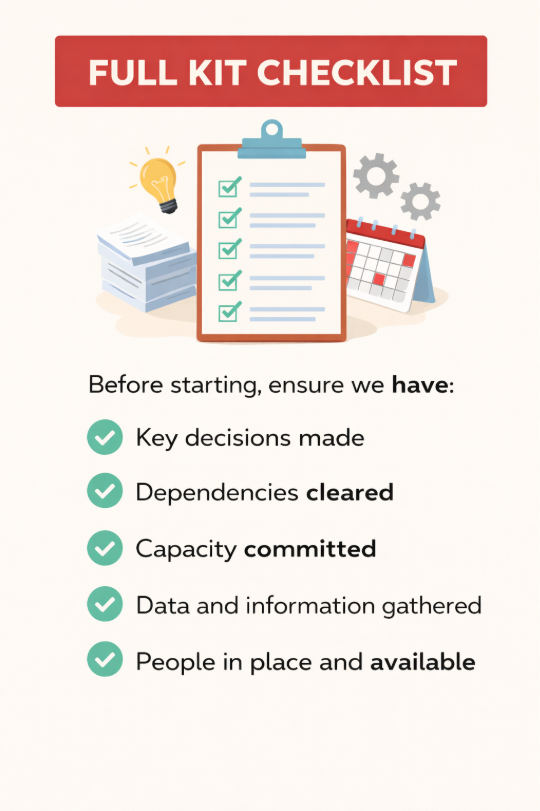
The rule is almost embarrassingly obvious.
Before starting a piece of work, make sure you have everything you need to finish it.
It’s like cooking a meal. You don’t start chopping vegetables, heating pans, and turning on the oven only to discover you’re missing half the ingredients. Or at least… you shouldn’t.
And yet, in organizations, we do this all the time.
Work starts without clarity.
Initiatives begin without decisions.
Teams are asked to “just get going” without the people, data, approvals, or capacity they need.
Why? Because being seen to be active often matters more than being ready.
There’s pressure to respond. Pressure to show progress. Pressure to demonstrate momentum. So we pick something up even when we know, deep down, that we don’t have a full kit.
The consequences are predictable:
- Time gets consumed on work that can’t be completed
- Stress ripples outward as we chase dependencies and favours
- Attention fragments across half-started initiatives
- Progress is performed, not delivered
All to what end? To look busy? To reassure someone that something – anything – is happening?
The irony is that this behaviour actively slows down the system. By starting work we can’t finish, we clog up the system. We reduce our ability to finish the work that actually matters.
The rule of flow is simple, but it’s not easy:
Don’t start until the full kit is in place.
That doesn’t mean everything must be perfect. It means the organization has made the necessary decisions, resolved the critical dependencies, and committed the capacity required to see the work through.
For leaders, this comes with a shift in posture.
Instead of demanding action, ask a better question:
What’s stopping us from picking this up properly?
That question surfaces constraints. It reveals missing decisions. It exposes systemic issues that no amount of “just try harder” will fix.
Flow doesn’t come from starting more work.
It comes from finishing the right work.


.png)